
 |
Artak GulianArmenian Monastery complex of Moscow is a weighty architectural and cultural presence in the Armenian Diaspora. The complex includes big and small churches, the building of Armenian Prelacy in Russia, cultural, educational institutions, and also reception facilities. This construction fully adheres to the national architectural principles and represents one of the works of architect Artak Gulian. |
 |
The Parable of StewardsAra, Manvel and Narek are classmates. Manvel and Narek are fond of the same girl and there is a silent competition between them. All four of them voluntarily participate in the construction of a house for a needy family with the support of the Church. The Priest notices that Manvel is absent and find out from his friends that because of a lower grade at school he is offended from his friends. The priest visits the boy and tell him the Parable of Stewards… |
 |
Crisis of Public EducationWhat mentality does the modern public school shape, what values lie in the foundation of out nurturing, what is the model Armenian school. Within the scope of the topic “Crisis of Thought”, the issues of public schools are addressed by the ethnologist Ruzanna Tsaturyan and the programmer Aram Apatyan. The conversation is conducted by Anna Sargsyan.
|
 |
Prayer in the PaintingRev. Fr. Nerseh Khalatian can no longer think his life without painting. “Painting is something like a prayer to me, - says the Father, - a kind of a unique way of self-concentration and connecting to the Exalted, which makes you to contemplate and create”. Father Nerseh was born in Tiflis. After the graduation of Gevorgian Theological Seminary, he was appointed as the Director of the Museums of Mother See, later – as the Patriarchal Primate of Central and Northern Europe. However, his most crucial experience was his service in an ancient Monastery of Haghartsin following that of in the Europe. It was here that his very first prayer was born in a painting. |
 |
Relic and ScienceThe attitude of a believer to the saints and sacred relics is as old as the Christianity itself. However, certain events that took place over the course of various historical periods made the attitude to relics change. Science too made an attempt to play decisive role in it by offering his services to test the authenticity of relics… The relationships between faith and science on sacred relics are explained and interpreted by Rev. Fr. Asoghik Karapetian, Director of the Museums, Archives and Manuscript Repository of the Mother See of Holy Etchmiadzin, archaeologists Artak Gnuni and Igit Gharibyan. |
 |
Varazdat HambardzumyanNational master Varazdat Hambardzumyan recalls 1992, when cold silence dominated everywhere and it was so hard to live. It was then that he created his first khachkar (cross stone).
|
 |
Spiritual awakening of TatevFather Michael Gevorgyan serves in Tatev Monastery. From 1927-2008, the Monastery had no clergy, all religious rites were forgotten, people were skeptical towards the priest coming to the village, and sometimes denounced them. Hard temptations were awaiting Father Michael, his only hope was his loyalty to official covenant... |
 |
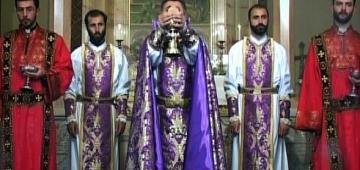
Eternal Mystery, Liturgical Attire, part 2The liturgical attire of the celebrant priest is different from his every-day garment not only with its glitter. The attire consists of a dozens of garments and every single one has its sacrament. Before the liturgy the change of attire of the celebrant that takes place in the sanctuary, is a ceremony which makes the celebrant ready for the service. What garments does the liturgical attire include, what prayers and verses from Scriptures are read, how the believers should get ready to partake in the Divine Liturgy - all these topics are covered by Reverend Father Asoghik Karapetyan. |
 |
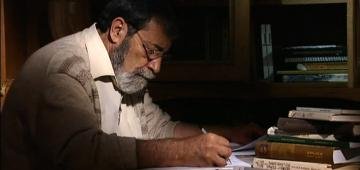
Liturgical Attire, part 1The liturgical attire of the celebrant priest is different from his every-day garment not only with its glitter. The attire consists of a dozens of garments and every single one has its sacrament. Before the liturgy the change of attire of the celebrant that takes place in the sanctuary, is a ceremony which makes the celebrant ready for the service. What garments does the liturgical attire include, what prayers and verses from Scriptures are read, how the believers should get ready to partake in the Divine Liturgy - all these topics are covered by Reverend Father Asoghik Karapetyan. |
 |
Ruben Hovsepyan"God is in me, therefore I strive for perfection... And every single man is like that, as much God as he can place within himself, as much he can say that God is in me". This is how Ruben Hovsepyan, writer, screenwriter, interpret the title of TV series, thus exposing himself... |
 |
Deacon ArtilleristIn the times of Artsakh heroic war, many of Armenian priests were fighting shoulder to shoulder with soldiers in the battlefield, and ofter with a weapon in hand. Deacon RafayelKhachatryan was one of them. Dropping his studies in Gevorgian Theological Seminary halfway, he returned his native land -- Martakert and positioned on the border. According to one of the commanders, Rafik was one of those distinguished mortar gunners whose shoot was the most exact and his gaze -- the sharpest. |
 |
Sacrament of Resurrection, part 2Why is the sacrament of resurrection considered to be the core of the Christian faith? What does it mean to believe in the miracle of resurrection? Is it a miracle in reality? Perhaps the faith for resurrection is meant to overcome the fear of death? Is it human to doubt in the resurrection of Christ? Is faith and resurrection subject to be scientifically proved? 21 centuries have passed since the resurrection of Christ, has the human understanding of Resurrection changed since then? |