 |
The 11th volume of the Mother List of Armenian Manuscripts has been publishedAfter a five-year hiatus, the Mashtots Matenadaran has published the 11th volume of the Mother List of Armenian Manuscripts. The editors of the volume are Gevorg Ter-Vardanyan and Gurgen Gasparyan. The 300 manuscripts are extensive descriptions of 312 manuscripts and 3 printed books included in the book, which were made by researchers of the Department of Manuscriptology under the leadership of the late Gevorg Ter-Vardanyan. |
 |
The Sunday school students of the Holy Mother of God Church staged a Christmas-themed performanceIn parallel with spiritual education, children learn singing, dancing, drawing, etc. in Sunday school. The Sunday school operating in the St. Anna and Catholic Church of the Holy Mother of God is attended by about fifty children. Sunday schools operate in almost all dioceses of the Armenian Apostolic Church, with the mission of educating a generation that is church-loving, patriotic, and has high values of Christian morality. |
 |
The museums of the Mother See of Holy Etchmiadzin have been equipped with radio guide equipment
Information about the relics and valuable works of art kept in the museums of the Mother See of Holy Etchmiadzin will now also be presented through radio guide equipment. During group tours, radio guide equipment in large halls will allow for a more comfortable excursion.
|
 |
The necklace from the History Museum was exhibited at an international exhibition in Britain
James Fraser, director of the Albright Institute of Archaeological Research in Jerusalem, was the chief curator of the international exhibition “Luxury and Power: From Persia to Greece” organized at the British Museum. He temporarily borrowed a gold necklace from the History Museum of Armenia for the exhibition, which has the shape of a plate. According to him, the necklace is made in the Armenian style, but the design and ornamentation are typically Achaemenid-Persian.
|
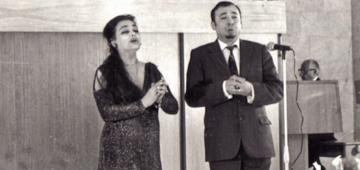 |
A memorial evening dedicated to Khoren Palyan was held at Lusine Zakaryan's house-museumIn the 1960s, Khoren Palyan and Lusine Zakaryan were among the first to become the bearers and disseminators of Armenian spiritual song. Khoren Palyan is the author of musicological, philological and historiographical articles and studies. He wrote the educational manual “Chronology of the Armenian Church”. He is a co-author of books and volumes dedicated to Grabar and hymns. He taught at the Gevorgyan Theological Seminary, at the Philological and Theological Faculties of Yerevan State University. |
 |
After Christmas, clergy perform a house blessing ceremonyTo proclaim the good news and distribute blessings, priests visit the homes of believers, bless the goods of the house and family members. According to the testimony of the evangelists, the ceremony of blessing the house was established by Jesus Christ, commanding his disciples to wish peace in that house when entering it. From the first century, the apostles visited the homes of believers to proclaim the good news of the Nativity and the Glorious Resurrection and distribute blessings. This spiritual and pious ceremony is continued by the Holy Apostolic Church to this day through the blessing of the house. |
 |
Photos of Kashatagh monuments collected in one bookJournalist, photographer Zohrab Erkoyan and Candidate of Philological Sciences, Associate Professor Mher Kumunts have jointly published the book “Historical and Cultural Heritage of the Nagorno-Karabakh Conflict Zone” in English. Zohrab Erkoyan photographed the monuments of the Kashatagh region between 1996 and 2020, most of which are included in the book. Presenting the rich cultural heritage of Artsakh, the authors try to bring the lost culture to life through photography. |
 |
The clergy performed a house blessing ceremony at the Saghmosavank monasteryFather Oshin Hayrapetyan and Father Paren Arakelyan from the Saghmosavank parish of the Aragatsotn diocese visited the home of a family forcibly displaced from Artsakh. The clergy brought the good news of the birth of Christ to a dignified working, creative, and productive family. They blessed the goods and residents of the home, told the children about the classes operating at the Saghmosavan Youth Center, as well as the Luys Children's program. |
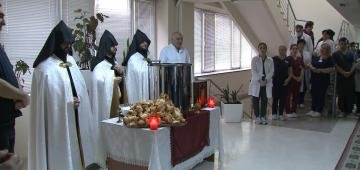 |
House Blessing and Water Blessing Ceremony was held at Izmirlyan Medical Center
The priest blessed the water, salt, and bread with the Holy Gospel, muron and cross, asking the Lord for bodily and spiritual healing and well-being within the threshold of each home. This order, established since the times of the apostles, is performed during the eight days following Christmas. Through the blessing of water, the sacrament of the Holy Baptism of Christ is transmitted to believing Christians.
|
 |
With the blessing of His Holiness the Patriarch, the "Armenian Christmas" spiritual classical concert took place
In the "Aram Khachaturian" Concert Hall, with the blessing of His Holiness Karekin II, Catholicos of All Armenians, the "Armenian Christmas" spiritual classical concert took place. The Armenian State Symphony Orchestra performed with the National Academic Choir of Armenia, sopranos Sarah Gilford and Siranush Gasparyan, mezzo-soprano Yulia Nikanorova, baritone Aram Khachaturian, and bass Hovhannes Nersisyan.
|
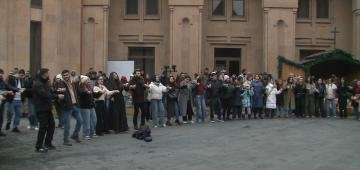 |
After the Christmas Liturgy, the holiday was celebrated with national songs and dances in the courtyard of St. Anna Church
With the efforts of the founders of the "Come Dance" initiative, citizens have been forming a dance circle for ten years. The number of citizens participating in the national song and dance is increasing year by year. The goal of the initiative is to continue the decades-long work of renowned choreographers, choreographers, and folklorists and to popularize Armenian dance.
|
 |
Catholicos of All Armenians visited Yerablur Military Pantheon with the Brotherhood of the Mother See
Led by the Catholicos of All Armenians, the Brotherhood of the Mother See visited the Yerablur Military Pantheon to pray for the repose of the souls of Armenians who sacrificed their lives for the defense of Armenia and Artsakh. Prior to that, a requiem service was held at the Mother See after the liturgy. The Monday following the Tabernacle holidays is the Day of Remembrance of the Dead. The Church urges that on that day, people visit the graves of the deceased and pray for them.
|