 |
Newmeg Publishing and AGBU Organize Genocide Studies WeekThe event featured a discussion with the author of the book “The Origins of the Genocide State” or “A Hundred Years of Apartheid” by Turkish historian Taner Akçam, in which Akçam criticizes Turkey’s hundred-year history, highlighting structural problems and the absence of democratic values. He notes that the history of the country’s founding is distorted and serves the regime. According to Akçam, Turkey’s state structure is based on discrimination, violence and oppression, which is reminiscent of the workings of the “apartheid” system. The Turkish historian suggests rewriting history from a new perspective, without propaganda, and calls for accepting the mistakes of the past so that Turkey can build a freer and more just society. |
 |
Eyewitness accounts on display at the Genocide Museum-InstituteFor a year, the Armenian Genocide Museum-Institute will host a temporary exhibition titled “Documenting the Crime: Eyewitness Documenters of the Armenian Genocide,” dedicated to the 110th anniversary of the genocide. The exhibition features testimonies from about seventy documenters from thirty countries around the world in the form of photographs, diaries, official correspondence, and personal belongings. |
 |
The torchlight procession reached the Tsitsernakaberd Memorial Complex on April 23 with the slogan "Do not renounce"
Archbishop Nathan Hovhannisyan, Director of the External Relations and Protocol Department of the Mother See, joined the Torchlight March on April 23 at the Tsitsernakaberd Memorial Complex. In his speech, the Archbishop emphasized the importance of efforts aimed at international recognition of the Armenian Genocide and condemned manifestations of genocide denial.
|
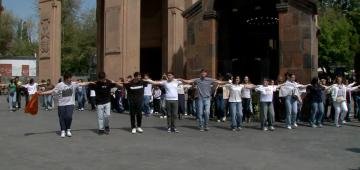 |
After the Resurrection Liturgy in the courtyard of St. Anna Church, believers danced in a circle
Every year on Easter and Christmas, the “Ari Pari” platform organizes a folk festival. The clergy welcomes the efforts of young people interested in national dance and supports them. The participants of the folk festival dance Ververi, Yarkhusta, and Kochari.
|
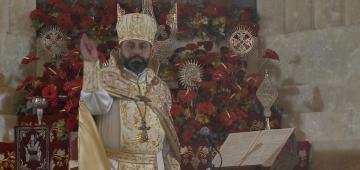 |
Candlelight Liturgy celebrated at St. Gregory the Illuminator Mother ChurchThe faithful have gone to St. Gregory the Illuminator Church to conclude Lent, receive Communion, and take home the good news of Christ's life-giving resurrection from the church. At the end of the liturgy, the faithful light a lamp from the church's lampstands and candles placed near the altar and take it to illuminate their homes. |
 |
Believers survived the final hours of Christ's earthly lifeAfter the order of crucifixion, the commemoration of the descent of Jesus from the cross and his burial was performed on Good Friday evening. The service of Christ's burial was performed in the Mother Cathedral of Holy Etchmiadzin under the presiding authority of the Catholicos of All Armenians. |
 |
In all Armenian Apostolic Churches, a Betrayal Service was heldThe Brotherhood of the Mother See, presided over by the Catholicos of All Armenians, participates in the sacred ceremony. The Order of the Eclipse symbolizes the memory of the betrayal and suffering of Christ. It refers to Good Friday, but is performed on the evening of Holy Thursday, since, according to the church calendar, the day begins after the evening service of the previous day. |
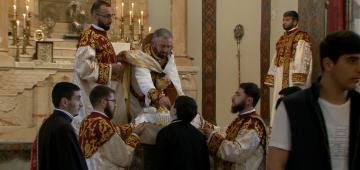 |
The Church commemorated the Last Supper of Christ and the sacrament of the Holy EucharistOn the morning of Holy Thursday, the Service for those who are fasting (Apashkharoghac) was held in the Mother Cathedral, followed by the Midday Service. The fasting faithful participated in the ceremony. On the morning of Holy Thursday, those who repent are granted absolution. Penitence is one of the seven sacraments of the Armenian Church. A penitent is a person who repents of a crime, offense, or mistake and is ready to atone for the sin. Those who sincerely repent and are granted absolution. |
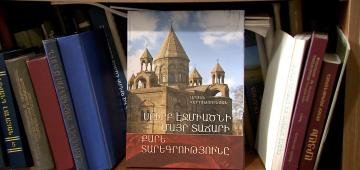 |
The monograph entitled "The Stone Chronicle of the Mother Cathedral of Holy Etchmiadzin" has been published
It is dedicated to the reconsecration of the Mother Cathedral and summarizes the lithographic heritage of the Mother Cathedral. For the first time, the construction and renovation works of the Mother Cathedral over the centuries are presented in the form of a chronicle, that is, in chronological order. The author of the monograph is lithographer Arsen Harutyunyan. The Armenian lithographs of the Mother Cathedral were studied in detail during the last large-scale renovation, when different layers of the walls of the building were opened.
|
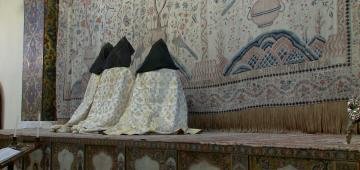 |
The Opening of the Doors ceremony was held at the Mother Cathedral on Palm Sunday evening
The Order of the Opening of the Doors symbolizes the Second Coming of Christ, when the gates of the kingdom of heaven will be opened for the righteous. It takes place in the form of a dialogue between the clergy, who are veiled, inside and outside the Mother Altar. The clergy kneel and ask the Lord to open the door of mercy so that the righteous may enter there.
|
 |
A festive liturgy was served on the occasion of Palm Sunday at the St. Gregory the Illuminator Mother Church in Yerevan
Spreading garments before Jesus symbolized confessing sins to Christ. Offering branches and twigs signifies special honors and solemnity. The olive tree was perceived as a symbol of wisdom, peace, victory, and glory. Offering olive and palm branches to Christ after raising Lazarus from the dead symbolized victory over death.
|
 |
Bible study classes are being held in the Artsakh dioceseBible study classes have begun at the "Entsa" center. The meetings were initiated by members of the Artsakh Diocese Youth Union. The classes are held in a question-and-answer format. The center has also been conducting Bible study classes for Artsakh children for a long time. In addition, the center, in collaboration with public and social organizations, implements psychological, social, spiritual, cultural and educational programs. |