 |
Unprecedented Persecution of the Armenian Church: Romanian and Bulgarian Press Response
Leading Romanian and Bulgarian media outlets are responding with particular attention to the criminal proceedings initiated in Armenia against the spiritual leader of the Armenian Apostolic Church and high-ranking clergy. The foreign press is describing what is happening as unprecedented persecution and political retaliation, noting that the state’s interference in the internal affairs of the church is evidence of a retreat from democratic principles in Armenia.
|
 |
The 75th Anniversary of the Birth of the Armenian Patriarch and a Half-Century Spiritual Journey
Today, August 21, marks the 75th anniversary of the birth of His Holiness Karekin II, Catholicos of All Armenians. A large part of his biography is a dedicated path of spiritual service.
The 132nd enthronement of the Enlightener, the Patriarch of the Armenian Church throughout the world, continues his half-century journey as a visionary shepherd, committed bishop and spiritual father, caring for every pain and sharing every joy of his people.
|
 |
Catholicos of All Armenians Receives Members of the Union of Christian Businessmen
On August 19, Karekin II, Catholicos of All Armenians, received members of the “Union of Christian Businessmen” at the Mother See of Holy Etchmiadzin, led by Father Ararat Poghosyan and the union’s co-founder Shavarsh Karapetyan.
Welcoming the visit of the union members, His Holiness conveyed his blessing to those present and emphasized the role of such initiatives in the development of the homeland and the improvement of public life.
|
 |
Day of the passed souls: Liturgy of Commemoration of the Deceased at the Mother See
On the day after the Feast of the Assumption of the Holy Mother of God, a Divine Liturgy of Commemoration of the Deceased was celebrated at the Mother See of Holy Etchmiadzin by Archbishop Torgom Tonikyan and a requiem service was held.
According to the doctrine of the Church, death is not the end of a person's existence, but a transition to eternal life, and on Day of the passed souls, the Church unites the living and the deceased through prayer and remembrance.
|
 |
Statement of the Armenian Diocese of Australia and New Zealand in Support of the Catholicos of All Armenians
The Primate of the Diocese, the clergy, the Diocesan Council and related bodies have issued a statement expressing their full support for His Holiness Karekin II, the Catholicos of All Armenians, the six bishops and the Mother See of Holy Etchmiadzin
|
 |
Archbishop Nerses Melik-Tangyan
In the bloody era of chaos, wars and the collapse of empires of the early 20th century, a clergyman lived and worked, whom the Tsarist gendarmerie called a "dangerous revolutionary", the Soviet Cheka organized assassination attempts against him, and the Armenians of Iran and Syunik considered him their savior and shepherd.
Archbishop Nerses Melik-Tangyan, Primate of the Armenian Diocese of Atrpatakan. A man who stood with the cross in his hand at the forefront of statehood.
|
 |
The year-end pedagogical meeting of the educational institutions of the Mother See took place
The year-end pedagogical meeting of the educational institutions of the Mother See, the Gevorgyan Seminary and the Vazgenyan Theological Seminary, was held at the Gevorgyan Theological Seminary, presided over by the Catholicos of All Armenians. At the end of the meeting, His Holiness addressed the educators who educate spiritual shepherds with a word of blessing and appreciation, urging them to be patient and principled in important matters, and wishing the workers of education hard and industrious work and a bountiful harvest.
|
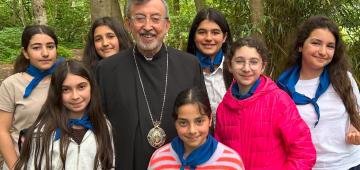 |
Armenian Cultural Heritage Learned at Camp in Belgian Community
About 120 children and youth, 43 clergy, teachers, and volunteers spent three days in an atmosphere of prayer, learning, games, and spiritual joy. During those days, the youth had a unique opportunity to deepen their knowledge of the Christian faith and to learn about the Armenian spiritual and cultural heritage through song, dance, and a variety of educational and entertainment programs.
|
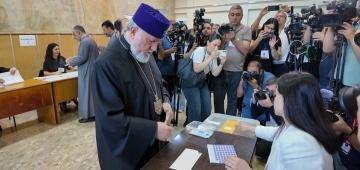 |
Catholicos of All Armenians Voted at the 14/11 Polling Station in Etchmiadzin
His Holiness arrived at the polling station accompanied by the Brotherhood of the Mother See of Holy Etchmiadzin. After the election, the Patriarch of All Armenians answered questions from journalists gathered near the polling station.
|
 |
Michael Hezemann
German writer, historian, and researcher Michael Hezemann was in Armenia on the occasion of the Armenian publication of the book “The Armenian Genocide.” In the interview, he talks about the newly discovered archives on the Armenian Genocide, his research, and the parallels he found when comparing the Young Turk and Nazi crimes. Michael Hezemann also touches on the current anti-church campaign in Armenia, examining and condemning such a situation from the perspective of a neutral researcher.
|
 |
On June 7, the Armenian Apostolic Church will celebrate the feast of Holy EtchmiadzinOn the occasion of the feast, a liturgy will be served in the Mother Cathedral, during which a prayer will be sung for the Armenian Church, people and homeland. A Republican wish will also be made for the unshakable and eternal radiance of the Mother See of Holy Etchmiadzin. The feast of Holy Etchmiadzin is one of the most important feasts of the Armenian Apostolic Church, dedicated to the vision of the founding of the Mother Cathedral. According to tradition, in 301, after Christianity was declared the state religion, St. Gregory the Illuminator had a vision in which he saw Christ descending from heaven, who struck it with a golden hammer and indicated the place for the future cathedral. |
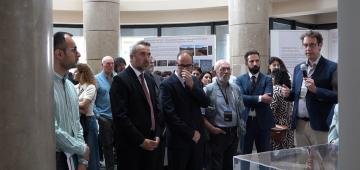 |
Armenian and German archaeologists present the oldest church in the region at Matenadaran
The unique church discovered during the excavations of ancient Artashat was most likely built by Trdat the Great and Gregory the Illuminator. The newly discovered structure was discovered by the joint Armenian-German “Artaxata” project, when archaeologists were excavating near Khor Virap. Archaeologists from the Institute of Archaeology and Ethnography and the Institute of Archaeology of the Ancient and Christian Periods at the University of Münster, after several years of excavations, confirm that the discovered octagonal structure is most likely the oldest church in the region.
|